
Managing wealth is primarily about asset allocation. The basis for choice of assets and the proportion that should be held in each investor's portfolio depends on his/her objectives and constraints. It is the core proposition of financial planning.

Investing in the stock market is an art that you need to learn.
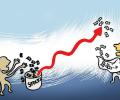
Small stocks made a dashing comeback in 2020 after delivering negative returns in the last two years as increased retail investor participation in pandemic times saw small-cap index surging up to 31 per cent and outperforming the bigger benchmark gauge. This year turned out to be eventful for the equity market, witnessing bearish and bullish sentiments at different points of time. While the initial part of COVID-ravaged 2020 saw the bears in full force amid concerns related to the pandemic and lockdowns hurting economic activities, bulls made a comeback towards the latter half of the year. As the market swayed with many lows as well as highs, small and mid-cap indices emerged as markets favourites in 2020.
Is Anjani Sinha of National Spot Exchange being made the fall guy?

While the market may remain volatile this year, analysts expect equities to deliver positive returns by outperforming inflation and government bonds, supported by the fiscal stimulus in the US.

From the pandemic shocks to state polls to global trends, a raft of sentiment drivers are expected to steer the Indian stock market in 2022 after a historic year of massive investor returns and milestones. The Union Budget, which will be closely watched for further reform moves, and quarterly earnings of corporates will be among the developments on investors' radar amid global central banks moving towards tighter interest regime in the wake of inflationary pressures. The year 2021 was rewarding in a big way for equity investors.

The men with guns tend to know little finance, and establishing such a conspiracy then involves leakage of information, which is also dangerous, Ajay Shah points out.

In six trading sessions to Friday the market capitalisation of BSE-listed companies saw a massive decline of Rs 11,76,985.88 lakh crore. All Sensex components were trading in the red, led by losses in Tata Steel, Tech Mahindra, Infosys, Mahindra and Mahindra, Bajaj Finance, HCL Tech and Reliance Industries.

More than 1,500 shares listed in Shanghai and Shenzhen dived by the daily limit.

The Adani stock price saga will pass into public memory as one of those matters that simply escaped being nailed down, perhaps because too many vested interests were involved, notes Debashis Basu.
Sensex crashed more than 1,000 points in opening trade. Asian stocks plunged too on Friday.
Valuations of broking companies have halved since January 2008. Patient investors can start accumulating selective stocks with a long-term perspective.
History shows that the large caps stage a fast recovery, whereas penny stocks continue to languish in the aftermath of a market crash. For instance, 884 penny stocks (those trading below their paid-up value and comprising 31.5 per cent of all traded stocks) have not yet seen their highs of May 10, 2006.
The United Progressive Alliance's much-touted Common Minimum Programme was given a resounding thumbs-down by the stock markets on Friday, with the Sensex crashed by 223 points (4.4%) to close at 4,835.
Overall market open interest on NSE down 15 per cent to Rs 89,307 crore (Rs 893.07 billion). A majority of stock brokers have unwound their leveraged positions in the futures and options segment. The total leveraged position (in excess of Rs 1 lakh crore or Rs 1 trillion) contributed heavily to the stock market crash.

Dragged down by a massive fall in the stock market, total investor wealth slumped by nearly Rs 3 lakh crore on Tuesday as shares of over 2,200 listed firms ended in the red.

A fresh PIL was filed on Thursday in the Supreme Court seeking a probe by multiple central government agencies under the supervision of a panel or a former apex court judge against the Adani Group of companies following allegations of fraud and share price manipulation made by the US-based Hindenburg Research.

Operator syndicate could be behind stock hammering, suspects regulator.

Just when stocks are seen as invincible, we should worry, warns Akash Prakash.

The Centre has no objection to a proposal for setting up a panel of domain experts to look into strengthening the regulatory mechanisms for the stock market, the Supreme Court was told on Monday while it was hearing pleas relating to the Adani stocks rout after the Hindenburg report. The central government, however, told a bench headed by Chief Justice DY Chandrachud that it wanted to give the names of the domain experts for the committee and the scope of its mandate in a sealed cover in larger interest.

Domestic equity investors' wealth eroded by more than Rs 4.43 lakh crore on Monday as fears of a financial contagion triggered by one of the biggest bank failures in the US roiled market sentiments. After a strong opening, Indian stocks went into a tailspin with the benchmark 30-share BSE Sensex tumbling nearly 900 points to close at 58,237.85 points -- sliding for the third straight trading session. The NSE Nifty too declined 258.60 points to end at 17,154.30 points.
The recent stock market crash has been particularly harsh on one investment category -- mid cap stocks/funds. Compared to their large cap peers, mid cap stocks/funds have fallen more sharply. The view that many frustrated investors might take is that investing in mid caps was a bad idea in the first place. And they can't really be blamed, in many ways mid caps were presented as an opportunity to make quick money without informing the investor of the higher risk involved.

The Centre has no objection to a proposal for setting up a panel of domain experts to look into strengthening the regulatory mechanisms for the stock market, the Supreme Court was told on Monday while it was hearing pleas relating to the Adani stocks rout after the Hindenburg report.

The equity cult has grown at a rapid pace in India in the last few years, with retail investors latching on to the stock markets like never before. At 126.6 million, the number of dematerialised (demat) accounts, where investors hold their securities in electronic form for trading purposes, are at record high levels. The growth rate, on an annualised basis, stood at 27 per cent in 2022-2023, up from barely 6 per cent a decade ago.
Corrections are a part of the game and if you are a longer term investor and if you have spare cash I would use these large declines to pick up quality stocks, says market expert Pranav Sanghavi.
Invest in an NFO to meet your needs, and not because it sounds cheap.
The near-term prognosis isn't good. For the last three years, the Indian stock market has ridden to successive highs on a tsunami of forex inflows. A large proportion of that is through participatory notes. A lot of that money will flow out in the short run.

Without knowing companies you cannot make the most of this opportunity to pick up quality stocks. Here's where you should go for information you can trust.
The 15% meltdown in the Bangkok bourse following currency-control measures highlights the volatility of developing markets as the dollar swoons.

Major realty firms, including Emaar MGF and Sahara, on Tuesday approached market regulator Sebi for public offerings to raise collectively an over Rs 11,000 crore (Rs 110 billion), reflecting that sector has emerged from the worst of the global financial crisis.
Apart from signalling the shape of things to come, the stock markets are seen as an important source of funds for investment - so their health can be critical.
No one can predict markets accurately. Only one can give a sense of things that can happen, says market expert Pranav Sanghavi.
Multi-cap funds have the flexibility to invest across the market cap segments. This should mean returns that beat diversified equity funds. But, what we find is their returns are similar

The Supreme Court on Monday refused to take on record the suggestion of one of the petitioners and a report published by Forbes in a batch of PILs on the recent Adani group shares crash triggered by Hindenburg Research's fraud allegations.
According to data from AMFI (Association of Mutual Funds in India), Rs 12,079 crore (Rs 120.79 billion) came into the new schemes in January alone. In December 2007, inflows were to the tune of Rs 10,273 crore (Rs 102.73 billion).

It was a 'Black Monday' again in markets today and history shows that seven out of the ten biggest carnages on Dalal Street has taken place on a Monday!

'If you are invested in mid-cap and small-cap stocks, even if you are making losses right now, it is better to sell them now and sit on cash.'

It has been a difficult year for the world's second-largest economy.
 © 2026 Rediff.com - Investor Information - Advertise with us - Disclaimer - Privacy Policy - Sitemap - Feedback - About us - Terms of use - Grievances